Red Sea Brief #19: Houthis On A Rock In The Strait
September 1–13, 2026: Insurers Lock In Red Sea Exclusion, Jordan Tenders Oil Port, Egypt Posts Record Reserves & More
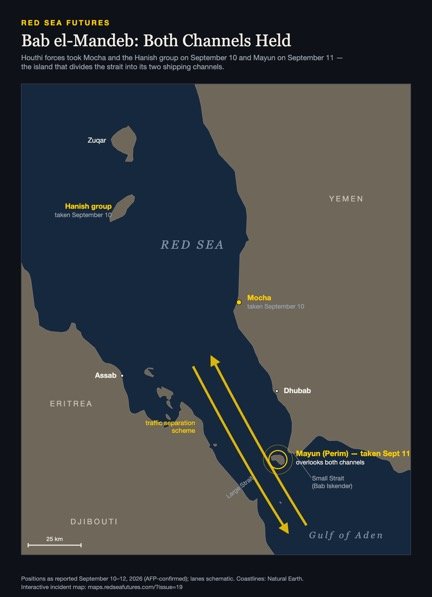
Note: our interactive map shows where the events behind Red Sea Futures’ columns — the Red Sea Brief and the Red Sea Legal Letter — took place. Red Sea Futures’ proprietary agentic model assisted in the creation of this report.
Yemeni Houthi forces took the Red Sea port of Mocha on September 10. The next day they crossed to Mayun island, in the center of the Bab el-Mandeb strait, in the process gaining “more direct” access to the far (Western) channel of Bab el-Mandeb. How much of a strategic win this is, is open to debate. Saudi Arabia answered with airstrikes on Mocha’s airport, and on September 11 its energy ministry confirmed it had shut the Kingdom’s bypass export artery to its Red Sea coast — Petroline — following drone strikes launched from Iraq. On September 25 United Kingdom Mutual Steam Ship Assurance Association, a mutual insurer behind much of commercial shipping’s liability cover makes its Red Sea war-risk exclusion a permanent term of its policies. Meanwhile Jordan issued two tenders for a new oil port. Egypt’s net international reserves reached a record $57.214 billion at the end of August while the cabinet approved about $3 billion of new external borrowing for the 2026–27 fiscal year. The Security Council, split over a US proposal to extend the Darfur arms embargo to all of Sudan, extended the existing measures by one month, to October 9.
The Houthis Are Closer to Both Channels Of The Strait - How Much (More) Does That Give?
Houthi forces took Mocha on September 10 and moved into the Hanish and Zuqar island group further north the same day (see map), then crossed to Mayun on September 11 after Yemeni government forces withdrew (see map). Mayun is a 13-square-kilometer volcanic island that divides Bab el-Mandeb into eastern and western shipping channels.
A senior official of Yemen’s internationally recognized government and a Houthi official separately confirmed the landing on Mayun to Agence France-Presse; the government official said the landing force was “not large” and had taken position on the hills overlooking the strait rather than garrisoning the island. The offensive has killed more than 500 people and displaced about 46,000, the UN migration agency said September 11. About 4 million barrels of crude and refined product a day passed through Bab el-Mandeb before the attacks began.
Houthi military spokesman Yahya Saree said the same day that “maritime navigation is safe for all companies except for Saudi vessels, which have already been banned.”
But the threat is not new, and its effectiveness rests more on sporadic hits rather than effective blockage or enforcement. The Houthis have demonstrated their ability to menace Red Sea shipping — Brief #17 recorded the Saudi-linked targeting test at sea, and Brief #18 recorded Mocha’s closure after more than 25 missile attacks — but it is difficult to see how Mayun would allow the Houthis more than incrementally better surveillance and targetting capacity. It would not relieve their cash or technology constraints. On the other hand, it’s a major publicity win — at home, and abroad, and for the internationally-recognized Yemeni government as well:
Yemen’s Presidential Leadership Council convened its National Defense Council under President Rashad al-Alimi the same day and called on the Security Council and the Red Sea littoral states to prevent Bab el-Mandeb and Yemen’s coasts and islands from “transforming... into extortion tools or platforms threatening international navigation and commerce.”
On September 8, before the coastal push, Houthi drone and missile attacks set fires at Saudi oil facilities and wounded 73 people see map. On September 11 Saudi aircraft struck the airport at Mocha (see map). Strikes and counterstrikes continued through September 13, when Yemen’s army reported hitting Houthi vehicles at Dhubab and inside Mocha; the Houthis say a Saudi strike on a prison in the city killed seven people, a toll not independently confirmed see map. On the day Mayun changed hands, Saudi Arabia’s energy ministry confirmed that drone strikes launched from Iraq had forced the shutdown of the East–West pipeline (aka “Petroline”), that carries crude from the eastern fields to Yanbu on the Red Sea coast — the kingdom’s main export channel bypassing Hormuz. Riyadh said it would not retaliate for now, at the request of Iraq’s prime minister.
Security analyst Wolfgang Pusztai told Al Jazeera the Houthis now have “the real capability to shut down any maritime traffic through Bab al-Mandab if they want to”; Andreas Krieg of King’s College London called the island “difficult to defend against an amphibious assault in the long run.” It is a real question, however, just how much the Houthis have gained in terms of offensive capabilities they did not already have from the Eastern shore. Historically few powers, including the British, and much more recently, the Emiratis, manned Perim for long (the British had control, but not a permanent garrison since 1839) — in part because it did not offer a decisive strategic advantage, and was difficult to defend.
On August 1 the Houthi-run Humanitarian Operations Coordination Center denied a Reuters report that the Houthis were preparing to charge a Bab el-Mandeb transit fee, a proposal the Houthis reportedly raised with Iranian officials during a July visit to Tehran; Yemen’s foreign minister-designate said the Houthis were trying to “copy the Iranian model” of strait control. Arguably the Houthis did the opposite, helping Iran prove out the Hormuz scheme since 2023, through informal payment /protection scheme for transiting vessels.
MSC, the world’s largest container shipping line, earlier this month had initiated a limited return to the canal — seven ships sent east through Suez and Bab el-Mandeb in the two weeks to September 12, according to Linerlytica, several going dark on their Automatic Identification System (AIS) transponders. The seizure of Mocha and Mayun has apparently not changed this, which was a Brief #18 watch item. On the other hand, Aramco’s August 30 restart target for the Jizan refinery, after two Houthi attacks in late July, has passed with no public confirmation that the plant is running.
Follow Insights by RSSGet the weekly Red Sea Brief on Substack