The Open-and-Shut Strait
Red Sea Intelligence Brief #6 · April 13–20, 2026
Editor’s note: This week’s brief draws on Red Sea Futures contributors in a background and reference capacity rather than as direct commentators — the week moved too fast for a proper roundtable, and we wanted to get to print before Wednesday’s ceasefire deadline. Contributors cited are identified in bold at first mention. Full bios at redseafutures.com/about-us.
In addition to client work, Red Sea Futures produces a detailed weekly risk survey and monthly strategic roundup. What follows is a condensed summary of this week’s work — also available on Substack
PART I: The Week In Brief
This was supposed to be the week the Strait of Hormuz reopened. On Friday, Iranian Foreign Minister Abbas Araghchi posted on X that the strait was fully open and ready for full passage. Brent collapsed more than ten percent to $88.73, touching its lowest settlement since early March. Trump thanked Tehran on Truth Social. The Pakistan-mediated track looked, on the surface, close to a second-round breakthrough.
Forty-eight hours later, none of that was true.
On Saturday, Iran reversed the announcement. The IRGC's joint military command, in a statement carried by Tasnim, said the strait would 'remain tightly controlled and in its previous condition' until the US restored 'full freedom of navigation for vessels travelling from Iran to their destinations and back' — explicitly conditioning reopening on the US ending its blockade of Iranian ports. Iranian gunboats fired on two tankers mid-transit, and the head of Iran's National Security Commission framed the reversal as a response to 'America's untrustworthiness.'
On Sunday the U.S. Navy seized an Iranian-flagged cargo ship in the Gulf of Oman after it attempted to run the blockade, creating the first boarding of the war. Brent snapped back above $95 by Monday morning. U.S. retail gasoline hit $4.05.
The ceasefire that started April 8 expires at midnight GMT Wednesday, April 22. Vance, Witkoff, and Kushner are airborne for a second Islamabad round; as of Monday afternoon Tehran was still publicly denying it would attend. Pakistan has deployed roughly 10,000 additional security personnel around the capital. This is the binding clock of the next 48 hours.
The Hormuz regime, for now: bifurcated
The week began under a different architecture. On Monday, April 13, U.S. Central Command (CENTCOM) implemented a full maritime blockade of Iranian ports under UK Maritime Trade Operations (UKMTO) Advisory 035-26, with three U.S. carrier strike groups (Bush, Lincoln, Ford) comprising 27 warships, about 41% of the globally deployed U.S. surface fleet. Trump warned that Iran-bound vessels would be “eliminated.” Three tankers tested the line on April 14 — the Chinese-owned, U.S.-sanctioned Rich Starry (carrying methanol, exiting the Gulf), the U.S.-sanctioned Murlikishan (inbound to load fuel oil at an Iraqi port), and the Panama-flagged Peace Gulf (carrying Iranian naphtha for the UAE’s Hamriyah port).
Per Kpler, LSEG, and MarineTraffic data, all three transited; CENTCOM publicly disputed the Rich Starry crossing on X, claiming six vessels were turned back in the first 24 hours. Whichever account holds, the de facto rule that emerged is not bound for an Iranian port rather than not Iran-linked.
The partial bypass architecture continued to hold. Saudi Aramco restored the East–West (Petroline) pipeline to full 7 million barrels per day (Mb/d) capacity on April 12, just 72 hours after an Iranian drone strike on a pumping station cut roughly 700 thousand barrels per day (kb/d) of throughput. The binding constraint is not the pipeline, rather Yanbu port at the western terminus. Of the 7 Mb/d flowing west, roughly 2 Mb/d feeds domestic Red Sea refineries (SAMREF, itself struck by IRGC missiles on April 3; Yanbu Aramco Sinopec; the Yanbu refinery complex), leaving about 5 Mb/d for export.
Yanbu’s two terminals have a nominal loading capacity of 4.5 Mb/d, an operationally tested ceiling closer to 4 Mb/d, and a wartime throughput estimate of roughly 3 Mb/d per Vortexa. Argus Media pegs the effective crude export ceiling at 5–5.9 Mb/d. Yanbu loadings have surged from ~1.1 Mb/d in February to ~2.5 Mb/d in March (a 330% increase per Windward), with 27 Very Large Crude Carriers (VLCCs, the supertankers that carry most long-haul oil shipments) observed routing toward the terminal against 18 for Jeddah — confirming the Red Sea pivot but also crowding a port complex that was sized for contingency, not sustained wartime load.
On the UAE side, ADNOC’s Abu Dhabi Crude Oil Pipeline (ADCOP, also known as Habshan–Fujairah) is running at or slightly above design capacity — Fujairah loadings peaked at roughly 1.9 Mb/d against a nameplate 1.5 Mb/d and an optimized maximum of 1.8 Mb/d. That pipeline now carries about 70% of UAE crude shipments, but there is essentially no spare capacity left to absorb additional diversion. Combined non-Hormuz Gulf bypass thus runs at approximately 6–7 Mb/d in practice against a theoretical 7.2 Mb/d ceiling, covering roughly 30–35% of Hormuz’s normal 20 Mb/d flow. The gap is not a rounding error, and the two bypass routes face different binding constraints: on the Saudi side, the pipeline has room but the port is saturated; on the Emirati side, the pipeline is maxed but the port has some slack. Either way, Saudi crude exports to Asia fell 38.6% in a single month, from 7.1 Mb/d in February to 4.4 Mb/d in March (per Bloomberg). This is the clearest single indicator that the bypass is releasing some pressure, not solving the problem.
This physical crunch is showing up in pricing, with one important caveat: because Hormuz is effectively closed to commercial traffic this week and Iran’s own export capacity has been hit by the US port blockade and the April 3 strikes on Bandar Abbas, the prices being posted this month are running ahead of any oil that is actually moving. Aramco set its May Official Selling Price for Arab Light crude to Asia at a record $19.50/bbl premium over the Oman/Dubai benchmark, locked in when Brent was near $109 in early April. Bloomberg’s trader survey had expected +$40 — meaning Aramco deliberately left about $20/bbl on the table to protect its long-term position with Asian buyers. With Brent then falling to $91–95 before rebounding on the blockade, the May price now sits $11–15 above what Asian refiners would pay on the open market if alternative oil were available in volume; most is not.
Chinese imports of Iranian crude hit 1.6 Mb/d in March, the highest since November 2025, but that figure is from before the blockade tightened and before commercial trust in the IRGC corridor collapsed after Saturday’s gunboat incidents. Saudi exports to China are projected to halve in May on the combined effect of Yanbu’s loading limits and the OSP hike. Riyadh is running well below the $108–111/bbl it needs — and the volumes it is shipping at that price are themselves well below what the pricing implies. This is the calculation behind MBS’ urging Trump to lift the blockade.
Commercial transit through Hormuz ran at roughly 14–16% of pre-crisis volume through mid-week — about nine tankers transited in the seven days ending April 16, 90% below February 27 baseline, per CNBC citing LSEG data. Friday’s “open” announcement added approximately eight vessels, according to Kpler, before Saturday’s reversal. On Sunday, April 19, no tankers transited the strait at all — one of the quietest days since the war began, per Lloyd’s List. Insurers did not reprice through the week. Maersk and Hapag-Lloyd entered crisis-committee mode without changing routing. The Iranian parliament’s construction committee chair, Mohammad Rezaei-Kouchi, signalled on April 19 that legislation was being drafted to bar vessels from “hostile” countries and require tolls from all others. This is not a reopening, this It is a claim of jurisdiction.
Container shipping: the 1,000-ship traffic jam
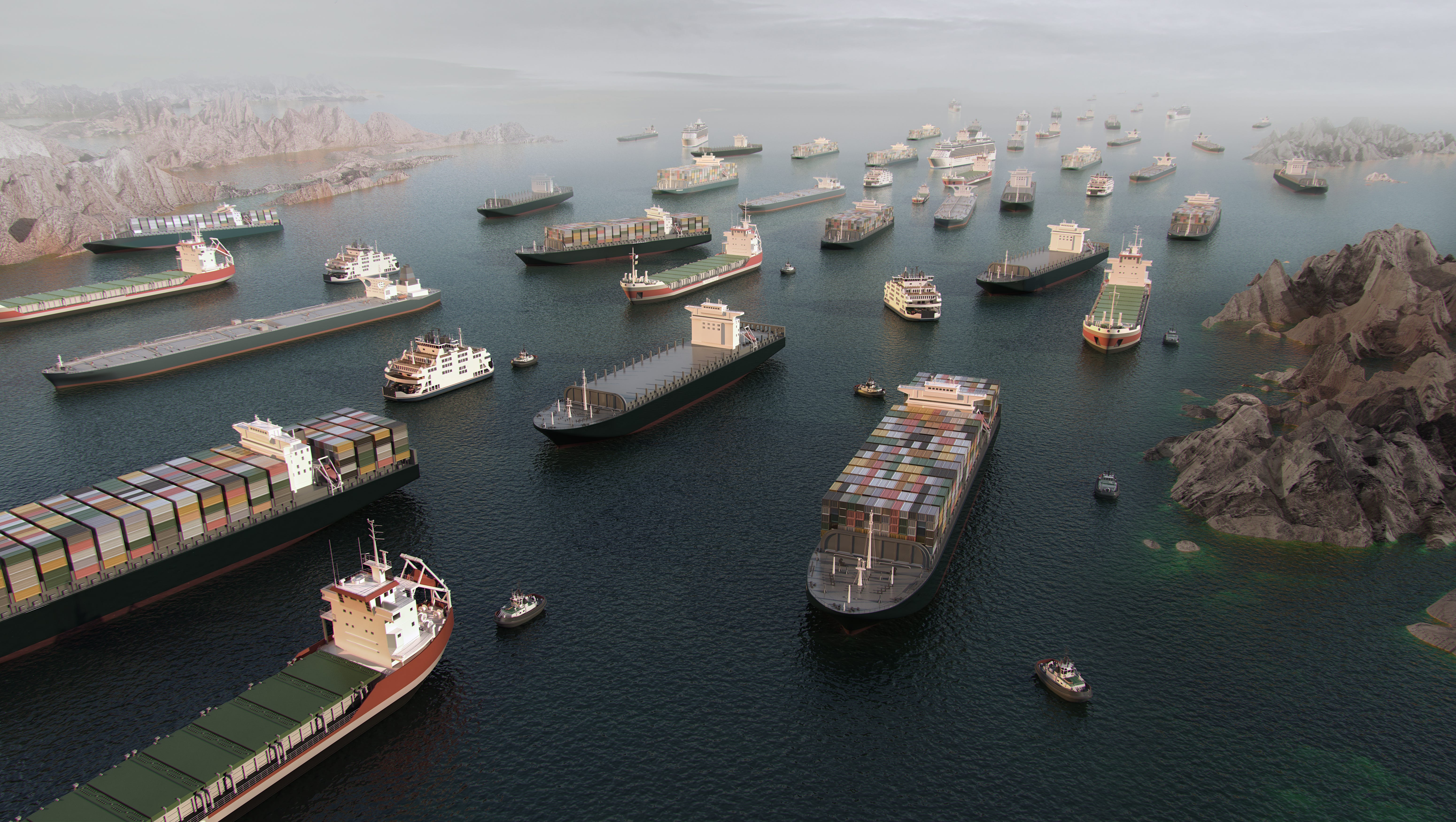
The tanker story has dominated coverage because oil prices move on it, but the container shipping disruption is arguably more structurally serious. The world’s four largest container lines (Maersk, MSC, Hapag-Lloyd, and CMA CGM) all suspended Hormuz transits in early March and have held that posture through this week. By Hapag-Lloyd’s estimate, roughly 1,000 merchant ships are stuck inside the Persian Gulf, clustered around Dubai and Khor Fakkan, waiting to leave. Hapag-Lloyd alone has six container ships trapped inside; CEO Rolf Habben Jansen told customers this month that even if a durable ceasefire holds, full network normalization would take six to eight weeks. Lale Akoner of eToro told CNN the full recovery horizon is closer to six months.
The first-mover problem has kept containers pinned. Lines are “basically waiting until others test” passage, per Flexport’s Manders. The firm that sails first assumes the insurance cost, the navigational risk of the Larak corridor, and the political exposure of paying IRGC fees. Oil tankers and Chinese-origin vessels are expected to test the waters before container lines move.
The knock-on effects are now surfacing beyond the oil market: European airports warned the EU transport commissioner this month of a “systemic” jet-fuel supply crunch within three weeks, and the Jebel Ali / Khor Fakkan transshipment cluster that normally feeds East Africa, the Subcontinent, and the Eastern Mediterranean is operating at a fraction of its normal throughput. Doraleh in Djibouti is absorbing some of the diversion; the rest is simply not moving.
Iran’s Hormuz control manifests in routing through a single corridor between Larak Island and Hormuz Island, entirely inside Iranian territorial waters, with the IRGC requiring documentation and — in some cases — payment for passage.
Lloyd’s List Intelligence tracked 50 of 72 total Hormuz transits between April 6 and April 12 using this route. As Danial Kaysi and Robert Springborg flagged in Issue 3 (”The Toll Booth on International Waters”), this arrangement is difficult to square with the UN Convention on the Law of the Sea: the Strait of Hormuz is an international strait governed by transit passage, a right that cannot be suspended or conditioned by the coastal state, and the shipping lanes run through Omani territorial waters, not Iranian. Kaysi’s Issue 3 analysis also noted that Iran’s fifth ceasefire demand — recognition of Iranian sovereignty over Hormuz — would formalize exactly this contestation.
U.S. Naval War College professor James Kraska told USNI News this week that the corridor now presents Washington with “a judgment or line drawing exercise” on whether IRGC payments constitute material aid to a sanctioned regime. The precedent, if it stands, is the one thing the post-war settlement cannot afford to ratify. It is why the Islamabad round-two framework, if there is one, has to resolve the strait’s legal status, not just the question of who is shooting at whom.
The Islamabad track, round two
Round one collapsed on April 12 after 21 hours over two points: the duration of nuclear constraints (Washington insisted on 20 years, Tehran offered five) and Iran’s refusal to relinquish the Hormuz toll regime. The blockade followed the next day.
The second round is being held under visibly worse conditions. Iranian Foreign Ministry spokesman Baghaei called the U.S. blockade “unlawful and criminal” and described further talks as “a media game.” Flight-tracking data showed four U.S. government aircraft landing at Nur Khan airbase in Rawalpindi on Sunday. Pakistan’s army chief Field Marshal Asim Munir traveled to Tehran mid-week carrying what officials described as a new message from Washington. Reported sticking points now include Iran’s uranium stockpile (a rumored $20 billion frozen-asset release in exchange for transfer of enriched material), the status of the blockade, and the IRGC’s de facto Hormuz authority — which Foreign Ministry messaging cannot deliver unilaterally.
The Pezeshkian-Araghchi public line and the IRGC operational line diverged visibly on Friday and Saturday. That divergence is the structural problem, and it is not resolvable inside a 48-hour window.
Bab al-Mandeb: the quiet that is not peace
The southern strait stayed militarily quiet. One skiff approach near Hodeidah on April 12 was the only incident; the Bush carrier strike group routed via Cape rather than Bab al-Mandeb, which is the truer measure of Houthi deterrent credibility than any transit count. Abdul-Malik al-Houthi’s April 16 speech was the turning point. He framed the Yemen front as past-tense achievement, i.e., Yemen had “prevented the Israeli and American enemy from the military use of the Red Sea”, without “zero hour” language, a threat of Bab al-Mandeb closure, or direct naming of Saudi Arabia. The late-March Mansour and al-Thawr ‘trump card’ warnings about Bab al-Mandeb closure remain in archive, unrefreshed.
Read this as Houthi leadership absorbing the Iran ceasefire as cover for stepping back, not escalating — holding the option without activating it. Fatima Abo Alasrar, writing with Olivier Le Cadre, captured the dynamic in an April 10 post on The Ideology Machine, describing the movement as “using the ceasefire to stand at the back gate, projecting Red Sea leverage that outpaces their actual capacity” — annexing Tehran’s deal into a Houthi victory narrative for Gulf, domestic, and Western policy audiences simultaneously.
In early April, Abo Alasrar told Al-Monitor’s Elizabeth Hagedorn that the Houthis' tentative entry into the war was a face-saving gesture meant for their anti-Israel base: "Just because they named the card, it's not the same as playing it.” Abo Alasrar noted that the Houthis cannot match the intensity of their prior attacks on maritime shipping in part because U.S. strikes on Bandar Abbas disrupted the Iranian supply chains powering local Houthi arms manufacture.
Saudi Arabia: the Vision 2030 reset
Saudi Arabia’s Public Investment Fund (PIF) Board approved the 2026–2030 strategy on April 15. Tourism megaprojects were deprioritized; The Line was pushed to a 2045 horizon; Oxagon (80% complete, green hydrogen) survived; capital was redirected toward AI infrastructure, with roughly 80% of PIF investment now intended to be domestic. Governor al-Rumayyan’s formulation was “no NEOM projects are cancelled” but “priorities reshuffled.” Expo 2030 and World Cup 2034 remain fully funded and on schedule. This is the first formal Saudi acknowledgement that wartime fiscal demands are crowding out the capital spending that Vision 2030’s marquee projects require — a structural shift, not a temporary squeeze.
The fiscal backdrop compounds the export problem described above. EIA projects Brent averaging $96 for 2026; Goldman’s year-end target sits at $50. Riyadh budgeted a 2026 deficit of 165 billion Saudi riyals (roughly $44B, 3.3% of GDP) — a figure written before Saturday’s Hormuz reversal and well before any honest reckoning with the fact that Saudi Arabia needs oil at $108–111/bbl to cover both the central government and the PIF’s spending commitments. Saudi-Iranian foreign-minister traffic ran hot through the week (three calls between FM Faisal bin Farhan and Araghchi, April 9–14). If both straits close simultaneously, Saudi crude to Asia ships through Bab al-Mandeb only — the scenario Riyadh is visibly working to prevent.
Egypt and the Suez question
The Suez Canal Authority withdrew its 15% large-containership rebate on April 7 — a clean admission that the rebate cannot pull carriers back while Hormuz remains constrained. Transits running around 56 ships per day against a 64 historical baseline; year-to-date revenue printing $449M through early February. French shipping major CMA CGM restarted its FAL1 Asia–North Europe service eastbound through Suez on April 6 — the first major Asia–North Europe route to break the wartime norm of diverting around the Cape of Good Hope. Westbound traffic on the same route remains on the Cape, and eleven other Ocean Alliance loops (the CMA CGM–COSCO–Evergreen–OOCL consortium) haven’t moved.
The gas-import shock continues. Liquefied natural gas imports tracking +26.3% year-on-year toward 11.14 million metric tons for 2026; March bill around $1.65B against a roughly $560M pre-conflict baseline. The Egyptian pound traded at 51.85 to the dollar on April 16, with the seventh IMF review and up to $1.65B in disbursement scheduled for June 15. SUMED — the Suez–Mediterranean pipeline that moves crude from the Gulf of Suez to Egypt’s Mediterranean coast, bypassing the Canal — is saturated at 2.5 Mb/d, 150% above its pre-conflict throughput. AD Ports is bidding for Egyptian Red Sea storage capacity at Ain Sokhna and Ras Badran. Charging for access to Egypt’s geography, which includes the Canal, SUMED, and Red Sea port infrastructure, is the one tool Cairo has for turning this crisis into revenue. The buyer on the other side of the transaction is Abu Dhabi.
Sudan at three years: Berlin, Burhan, and coalition pressure
The war crossed its third anniversary on April 15. The Berlin donor conference pledged €1.5B (EU €812M, Germany €232M, with U.S.-led tranches). The UN Emergency Relief Coordinator called Sudan “an atrocities laboratory.” World Food Program (WFP) rations remain at 70% in famine areas and 50% in at-risk areas; 19.1 million people are at IPC Phase 3 or worse (the international food-crisis classification, where Phase 3 is “Crisis,” Phase 4 “Emergency,” and Phase 5 “Famine”) during the February–May lean season; famine is confirmed in El Fasher and Kadugli with twenty further localities at risk. The Berlin pledge eases but does not close the $4.2B 2026 Humanitarian Needs and Response Plan gap.
The signal worth reading this week is the internal one. Burhan has spent the past six weeks managing a visible coalition rupture over Iran. On March 3–4, al-Baraa bin Malik Brigade commander al-Naji Abdullah, a prominent Popular Congress Party figure aligned with the Sudanese Armed Forces (SAF), publicly pledged to send Sudanese fighters to Iran if the U.S. or Israel launched a ground operation, in a video circulated online and reported by The National, Asharq Al-Awsat, and Sudan Tribune. Burhan publicly disavowed him; Abdullah was arrested March 15; the State Department designated the Sudanese Muslim Brotherhood and the al-Baraa bin Malik Brigade as Specially Designated Global Terrorists on March 9. Ali Karti, Secretary-General of the Islamic Movement in Sudan, separately framed the Iran war as aggression against “resistance forces”, a line Middle East Eye reported this month describes a broader split inside the SAF coalition, with Islamist formations largely sympathetic to Tehran and Burhan running the opposite public line.
The Sudanese Islamist posture sits at an odd angle in the broader picture. Hamas — materially far more Iran-dependent than any Sudanese formation — issued a rare public appeal on March 14 calling on “the brothers in Iran” to stop targeting neighboring Gulf states, which the Washington Institute read as a tilt toward the Qatar-Turkey Brotherhood axis under Doha’s pressure. That Sudanese Islamist auxiliaries went further than Hamas itself in public Iran-support posture underscores that Abdullah’s March speech was a message to the Islamist wing of Burhan’s own coalition as much as a policy statement, and makes Burhan’s management problem fundamentally a domestic rather than a regional one.
Against that backdrop, Burhan’s mid-April condemnation of Iranian strikes on Qatar, Jordan, Saudi Arabia, and Kuwait — without the UAE — reads primarily as a defensive signal to his own Islamist base that Port Sudan’s posture has not shifted, consistent with the pattern established February 28 and repeated through March. The week’s moves on tightening his military command (deputy posts abolished April 6, 21 major-generals retired April 11) run along the same line: managing his own camp, not repositioning externally.
The genuinely open regional question is whether the Egyptian-Saudi axis quietly accepts SAF control of Port Sudan and the Red Sea coast as the starting point for stabilization, or will ultimately make regime change a precondition. Berlin’s €1.5B pledge with no political settlement attached is the first signal that the wider donor track is moving in the direction of the former.
The Horn: Berbera goes public
On or about April 13, Somaliland President Irro publicly offered deep-water port and airbase access at Berbera to U.S. Africa Command (AFRICOM) commander Gen. Dagvin Anderson, framed explicitly against Hormuz closure and Houthi Bab al-Mandeb posture. The “longest runway in Africa” framing was deliberate. Israel separately appointed Michael Lotem as its first ambassador to Hargeisa, formalizing the December 2025 recognition. A Western/Israeli-aligned node 250 kilometers from Bab al-Mandeb is now actively under negotiation.
Djibouti’s President Ismail Omar Guelleh, re-elected April 10 with 97.81% on 80.4% turnout, publicly warned Somaliland that an Israeli base would threaten Red Sea neutrality. Doraleh is absorbing Jebel Ali diversion volumes with “ample waiting and storage capacity.” Mogadishu’s constitutional weakness limits its veto. An AFRICOM commander does not visit to demur; near-term trajectory includes the possibility of an MoU or test deployment within 60–90 days.
Ethiopia-Eritrea: fuel pressure as involuntary de-escalator
The Ethiopia-Eritrea file has been running on two conflicting clocks. On the escalatory side: Ethiopia mobilized forces toward the Tigray-Eritrea border through February; the Tigray Defence Forces entered Tselemt on January 26 and moved into Korem and Alamata without federal resistance; Abiy has publicly framed Red Sea access as an “existential” Ethiopian interest with Assab the target; Ethiopian officials claim Eritrean troops continue to infiltrate into Tigray; the International Crisis Group’s February briefing called the three-way tension between Addis Ababa, Mekelle, and Asmara a “powder keg”; Kjetil Tronvoll of Oslo New University rated tensions at their highest level since the 1998–2000 border war. The TPLF has issued a “national call” for Tigrayans to enter military service. On April 10, Isaias hosted China’s Special Envoy to the Horn and reportedly planned an Addis Ababa state visit around April 17, which if confirmed would be the most consequential bilateral signal in 18 months.
On the de-escalatory side, though: the Iran war’s downstream effect on Ethiopian fuel supply has materially narrowed Abiy’s room to act. Per Addis Standard reporting a Barron’s analysis, the federal government has asked citizens to limit fuel use and placed non-essential employees on leave in late March to preserve reserves. The April 8 extension of the Tigray Interim Administration mandate — read by Critical Threats Africa File as “averting Tigray war, for now” — is the first visible policy output of that pressure. If Hormuz reopens meaningfully and fuel supply normalizes, the constraint eases and the mobilization resumes. In that scenario the Iran-war timeline becomes a leading indicator for the Horn timeline.
PART II: What to Watch This Week
April 22, midnight GMT. Ceasefire expiration. Three possible outcomes: (1) extension via an Islamabad round-two framework, even a thin one, which buys another 10–14 days and keeps the gap between the Foreign Ministry and the IRGC manageable; (2) collapse without agreement, which restarts the shooting war with the Bush, Lincoln, and Ford carrier strike groups in position and returns Iran’s Hormuz control to open interference rather than tolling; (3) a Lebanon-coupling failure — if Israel resumes strikes on Hezbollah, Iran has already shown it treats that as a ceasefire violation and will pull Hormuz down as leverage even if Islamabad is formally still running.
Houthi leadership messaging. Watch for any refresh of the Mansour or al-Thawr “trump card” language on Bab al-Mandeb closure.
Saudi-UAE-Egypt axis. The AD Ports bid for Egyptian Red Sea storage is the concrete thing to watch — a real commercial move that reveals how seriously the Gulf-Egyptian partnership is thinking about hard infrastructure rather than communiqués. If the Islamabad round produces even a limited extension, expect Gulf-Egyptian capital coordination to accelerate. If it fails, expect the Crown Prince’s backchannel pressure on Trump over the Hormuz blockade to intensify and to produce a visible split on U.S. policy.
Berbera. A memorandum of understanding or framework announcement with AFRICOM in the 60–90 day window would be the most consequential Horn development of the year. Mogadishu’s retaliation menu is limited. Djibouti’s rhetorical opposition is not an operational constraint.
Sudan markers include whether the Berlin pledge actually disburses, whether Burhan's domestic consolidation holds against Islamist-faction pressure, and whether U.S. Sudan policy moves from outsourced to bilateral. Senator Risch (Senate Foreign Relations Committee chair) and Representative Meeks (House Foreign Affairs Committee ranking member) issued April 15 statements pressing the Trump administration on three specific fronts: a terrorist designation for the RSF; restrictions on U.S. arms sales to countries backing either belligerent; and a comprehensive bilateral U.S. strategy to replace the current outsourced approach. It’s unclear whether either Committee moves these bills, and if the administration pre-empts with its own strategy.
Red Sea Futures produces weekly intelligence briefs synthesizing proprietary AI-assisted analysis with expert commentary from a 230+ member network. Subscribe at redseafutures.substack.com.
For the full weekly risk report or monthly strategic roundup, subscribe at the Founding tier on Substack. For tailored engagements, visit redseafutures.com or email info@redseafutures.com.
Get the next issue by email.
Read/Subscribe on Substack →