The Red Sea Brief * Issue 13
A survey of the events and trends impacting the Red Sea and its basin states over the week ending June 19, 2026
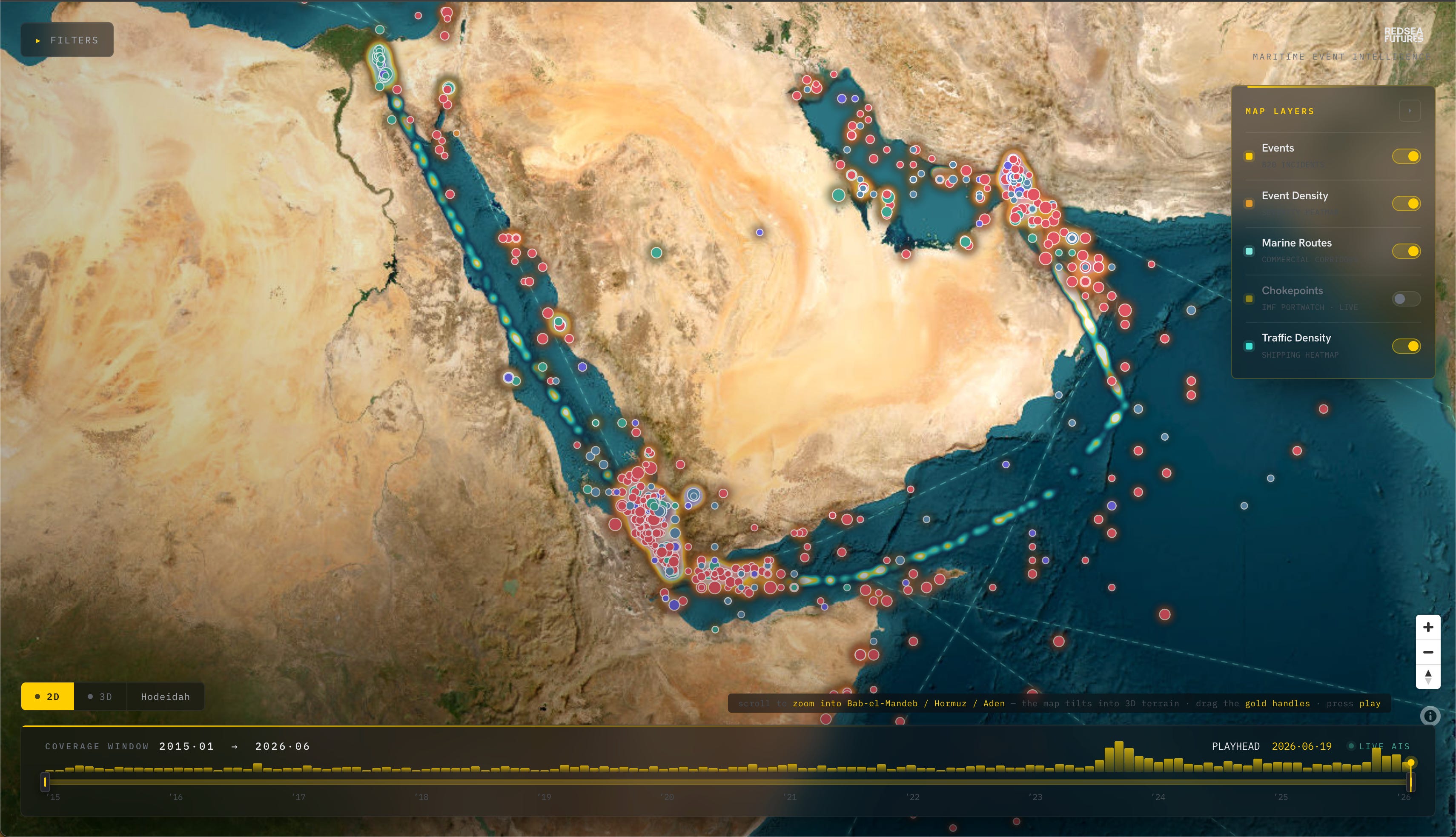
Note: Beginning next week, we include an interactive map siting the events and trends highlighted in all of our columns: the Red Sea Brief, the Fragility Tracker, and the Legal Letter.
Over the past week the Red Sea continued to be heavily influenced by events to the north, where the four-month closure of the Strait of Hormuz appeared to be coming to an end, following the war MOU signed virtually between the United States and Iran — promising cheaper shipping and a possible return of Saudi oil to the Gulf. At the southern gate, Bab al-Mandeb, the picture was quieter than some headlines suggest: the Houthis restated their ban on Israeli-linked ships the week before, but no commercial vessel has been hit, war-risk pricing has not moved, and our network reads Houthi statements as posturing rather than the start of any new campaign. The basin’s harshest reality continues to be a worsening war in Sudan, where the Rapid Support Forces (RSF) are now closing on the city of El Obeid.
The Houthi Posture
The Houthis’ relative restraint in the Red Sea is visible in the numbers. On 8 June (prior to the MOU) the Houthis reiterated their ban on Israeli shipping through the Red Sea — Israel-linked traffic has been routing around the Cape since 2023, which is part of why, as of 19 June, insurers had not raised war-risk prices, and no attack on a commercial ship of any flag had been confirmed this month. The 17 June memorandum did not touch the Houthi ban, and fighting between Israel and Hezbollah in southern Lebanon continued into 19 June, with Israel reporting four soldiers killed — a reminder that a renewed Iran–Israel fight, which would presumably scuttle the MOU, carries risks for the Red Sea as well.
Fatima Abo Alasrar reads the 8 June declaration as a warning shot rather than the start of a sustained campaign. The Houthis have a long pattern of firing into exactly these de-escalation moments, and she treats the ban as posturing accompanying the Houthis’ missile fire on Israel that same day, rather than a genuine opening of a southern-gate campaign. Abo Alasrar’s working view is that “the axis is wounded and can’t sustain much right now,” so whatever military response it can muster is far more likely to land on Israel directly than to become a general campaign against shipping.
The detail Abo Alasrar flags is a speech by Hezbollah’s Naim Qassim, who praised the Iranian outcome but insisted on no buffer zones and no Hezbollah disarmament. In her reading, that Lebanon-first, no-concessions line “reads less like a confident victor consolidating and more like a wounded actor refusing to formalize what the battlefield already cost,” and points to friction inside Lebanon rather than a coordinated push outward. Lebanon remains the place to watch — not because the Houthis are poised to widen the campaign on their own, but because a renewed Iran–Israel fight is the one event that could introduce more chaos into Red Sea shipping.
Saudi Oil Shift Raises Near-Term Stakes At Bab al-Mandeb
With Hormuz shut, Saudi Arabia moved most of its crude exports — about 3.65 million barrels a day in May — onto its Red Sea coast, loading at the terminal in Yanbu. That oil travels the length of the Red Sea and must pass Bab al-Mandeb to reach buyers in Asia.
In 2023 the Red Sea was a corridor a ship could avoid by sailing around Africa. In 2026 it became the loading coast for the region’s biggest oil exporter, and a serious disruption at Bab al-Mandeb would trap that crude at the source. This exposure now begins to ease: with Hormuz reopening, the first Saudi tankers crossed the strait again this week, and over time Saudi crude is likely to shift back toward the Gulf. But that shift will take months, not days, so for now the Yanbu route and Bab al-Mandeb still carry the load.
Markets: The War Premium Erodes
Oil fell sharply as the deal took shape. Brent dropped toward $78 a barrel on 18 June, its lowest since early March, after trading near $87 the week before and above $94 on 1 June. The fall erased almost all of the gains built up since the war began in late February. The first stranded tankers left the Gulf, and Kuwait said it would raise output.
This price drop is the most important market signal for the Red Sea coast, as it directly affects the Saudi budget. Near $78–80, Brent now sits at or just under the level the Kingdom needs to balance its books, estimated at $78–85 a barrel — and far below the figure needed once the Public Investment Fund’s own spending is taken into account. The cushion represented by $87 oil is gone. This situation highlights the backdrop to Saudi Arabia’s retreat from certain Red Sea giga-projects (see the forthcoming Fragility Tracker). Assuming (a strong if), the US-Iran agreement holds, network predicts further downward pressure. Michael Brill expects Brent below $78 within the next two months: “Given the expected oil glut of 2027, it seems likely. Even more so if Iranian oil is unsanctioned quickly.” The MOU, by letting Gulf producers restart held-back output, points the same way.
The Drewry World Container Index (WCI) reached $3,549 on 11 June, up about 27 percent from the last issue, driven by an early shipping peak season rather than by events in the Gulf. Those rates still rest on the higher cost of routing ships around Africa. As the southern Red Sea question and Hormuz both ease, that cost base faces its first real test in over a year, but a return of carriers to the Red Sea and Suez is far from instantaneous: major lines have already rebuilt their 2026 schedules around the Africa route, and a full unwinding will take months, if not longer.
Egypt Raises Suez Service Fees
On June 7 the Suez Canal Authority announced its first broad fee increase in three years, effective 15 July, raising tanker charges toward 37 percent and adding a 12 percent container fee for the first time, on the back of a 23.6 percent traffic rebound. A canal does not add a first-ever container fee on traffic it expects to lose, so the move signals confidence that the rebound will last. Robert Springborg reads the bet as resting on more than confidence: it reflects, in his words, “a combination of confidence that the agreement will be durable and desperation due to extreme budgetary pressure,” with debt service consuming almost 60 percent of Egypt’s 2026–27 budget and fewer bailouts expected from Gulf states.
Sudan: The War Closes On El Obeid
The most precipitous political/military deterioration in the basin this week was in Sudan. The Rapid Support Forces (RSF), the paramilitary side in Sudan’s civil war, massed troops around El Obeid, the capital of North Kordofan state and a gateway to the capital of Khartoum. Observers expect a large ground assault. Drones remained the main offensive instrument. Ten straight days of drone strikes killed at least 50 civilians across El Obeid and North Kordofan, and destroyed roughly eight fuel stations, cutting supply to the region’s largest city. A strike also hit a World Food Program aid convoy near El Obeid.
On June 18, 29 countries, including Britain, France, and Germany, told the United Nations Human Rights Council that the paramilitary force could imminently storm the city and commit large-scale atrocities, pointing to credible reports of ethnically targeted killing and sexual violence. The United Nations human rights chief, Volker Türk, called for the RSF to cease its offensive. The same drones killing civilians are reported to be disrupting the main food-aid logistics channel (see Fragility Tracker report).
The Horn of Africa: The Contest Sharpens
Moving South and East to the Horn, In talks facilitated by Egypt, Washington announced plans to lift the sanctions it placed on Eritrea in 2021 and reopen full relations. The move is generally read two ways: as a way for the US to develop another foothold on the Red Sea opposite Saudi Arabia and Yemen, while rivals court Asmara, and as a warning to landlocked Ethiopia not to seek sea access by force. Human rights groups have registered objections, citing, among other factors, Eritrea’s record in the 2020-2022 Tigray war.
These developments come against an increasingly tense backdrop many fear will erupt into a full-on war between Ethiopia and Eritrea, focused on the port of Assab (and by necessity, Tigray). In mid-May, Egypt and Eritrea signed a maritime pact declaring that Red Sea security to be the responsibility of the countries on its shores alone — a direct answer to Ethiopia’s push for sea access. Ethiopian Prime Minister Abiy Ahmed keeps pressing the case that being landlocked endangers a country of more than 120 million people. With Ethiopia holding national elections in June 2026, Red Sea access has become a useful rallying cause, raising the risk of a miscalculation. Read together, the United States’ opening to Eritrea and the Egypt–Eritrea pact strengthen Eritrea, and Egypt and constrain Ethiopia.
What To Watch
• Will the MOU stand? Does Brent hold toward $78?
• Will a Hormuz reopening pull carriers back toward the Red Sea and Suez — lifting Egypt’s traffic — or instead draw Saudi crude back to the Gulf and off the Red Sea coast?
• Does the El Obeid assault take place, and will it produce the mass-casualty event the 29-country warning anticipates?
• Will the United States–Eritrea opening and the Egypt–Eritrea pact provoke an Ethiopian counter-move around Assab, with the June elections as the flashpoint?
This Week’s Contributors:
Fatima Abo Alasrar — Yemen-focused policy and security analyst and MENA Director at Cure Violence. Former Mason Fellow at Harvard Kennedy School and Open Society policy fellow; advised the Embassy of Yemen in Washington (2006–2012). Writes The Ideology Machine on Substack. Holds graduate degrees from Harvard and Johns Hopkins.
Michael Brill — Middle East political analyst and Ph.D. candidate in Near Eastern Studies at Princeton, where his dissertation examines Baʿth Party founder Michel ʿAflaq. Visiting Scholar at Smith College; 2024–25 Wilson Center Global Fellow and Air Force Academy Non-Resident Fellow. M.A., Georgetown. Published in Foreign Affairs and War on the Rocks.
Ethan Chorin — Founder and CEO of Red Sea Futures; former US diplomat and Middle East analyst with 25+ years on Red Sea issues. Coordinated the region’s first multi-state ministerial climate summit (2015). Author of four books, including Benghazi: A New History and a forthcoming Red Sea history (Harvard). PhD, UC Berkeley. He writes The Middle East—Told Slant Substack.
Romaric Jannel — Philosopher specializing in ethics, AI, and comparative philosophy, with research on trust, responsibility, and agency. Program Director at the Collège International de Philosophie in Paris and Visiting Researcher at Ritsumeikan University, Japan. Ph.D. from EPHE–PSL University; recent work addresses trustworthiness in AI. Speaks English, Japanese, and French. He writes the Philosophy And Beyond Substack.
Sarah Deardorff Miller — Expert on refugee, migration, and humanitarian issues. Doctorate in international relations from Oxford; teaches displacement and humanitarian response at Georgetown. Senior fellow at Refugees International, with much of her research focused on the Horn of Africa. Author of books and reports on the politics of forced migration.
Al-Sharif Nasser bin Nasser — Middle East security expert and entrepreneur; founder of Ambit Advisory and Senior Advisor to UNIDIR on missiles, drones, and WMD. Formerly directed Jordan’s MESIS, leading regional CBRN risk work. WEF Young Global Leader (2015). M.A. in Near Eastern Studies, Princeton.
Robert Springborg — Authority on the political economy of Egypt and the MENA region. Research Fellow at the Italian Institute of International Affairs; former MBI Al Jaber Chair at SOAS and Director of the American Research Center in Egypt. Has consulted for USAID, State, and UNDP. Author of numerous books on the region, including the recent Making Aid Work, with Guilain Denoeux and Hicham Alaoui.
Subscribe to the Red Sea In Brief, a free publication, here. For Our Red Sea Legal Brief and State Fragility Tracker, choose the paid option. For bespoke analysis and consulting, visit us on www.redseafutures.com, or contact us on info@redseafutures.com
Get the next issue by email.
Read/Subscribe on Substack →