The Red Sea Brief * Issue 12
The Events and Trends Influencing the Red Sea and Red Sea Basin Over the Week Ending June 7, 2026
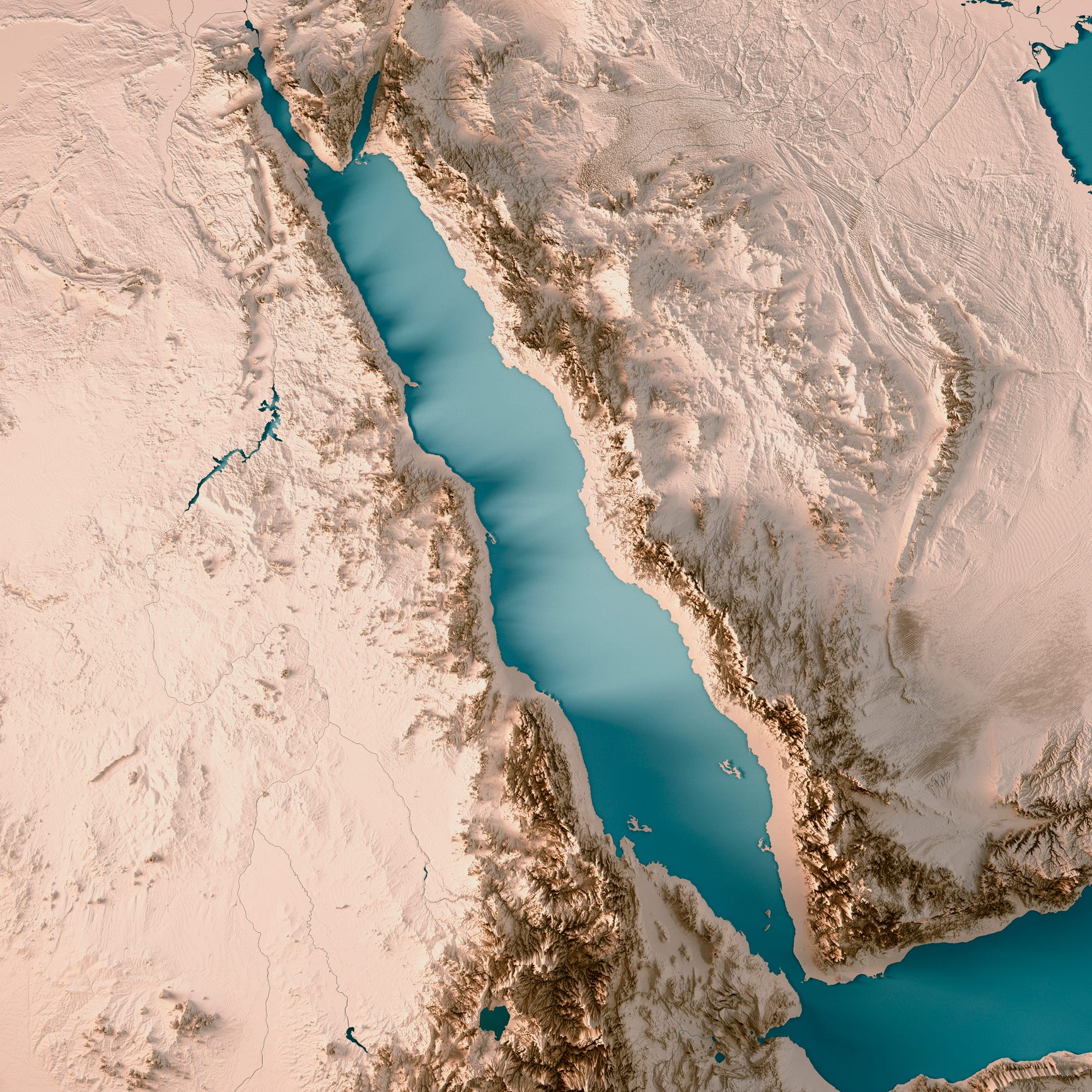
This is the weekly Red Sea Futures Brief, covering events and trends influencing the Red Sea over the previous week.
Subscribe to summary Red Sea coverage that integrates vetted data with insight from a broad range of area and technical specialists who have spent the majority of their lives and/or careers working in and on the region.
While attention this last week remained on the Strait of Hormuz and a US–Iran deal that fell apart almost as fast as it came together, pressure in the Red Sea basin quietly moved south — to Bab al-Mandeb, the Red Sea’s own front door, which Tehran publicly named its next lever.
The markets, for the moment, are unimpressed: freight, crude, and insurance pricing appears to consider Tehran’s threats a bluff. In the background, war is pushing deeper into Sudan’s Kordofan region, and the international aid system is running out of money, at a critical juncture. This post traces how a crisis born outside the basin keeps washing back into it, who in the Gulf can actually turn it off, and what the funding collapse looks like at the ground level.
The following post (Structural Stress and Capital Flows, and Legal Trends and Precedents) follows the money — freight rates on the Cape-route, Brent’s swing through the low $90s, Saudi giga-project reprioritization on the Red Sea coast, the Yemen import-finance squeeze, and Egypt is experiencing pressure at Suez. The third post of the week covers a.) the US designation of Iran’s Hormuz toll authority and what it means for Red Sea charter parties and insurance, b.) a relevant and record ITLOS (International Tribunal for the Law of the Sea (ITLOS)) award on wrongful vessel seizure, c.) a split between English and Australian courts on liability limitation, and d.) Gulf LNG force-majeure.
1 — Bab al-Mandeb - How Much Riskier As Hormuz Track Collapses?
On 1 June Iran threatened to “activate other fronts including the Bab al-Mandeb Strait” — the southern entrance to the Red Sea and the approach to the Suez Canal — tying the move to a full Israeli withdrawal from Lebanon and Gaza, and saying any action would run through the Houthis, in whose adjacent waters roughly a quarter of world shipping passes [11][12].
The threat is Red Sea spillover. The southern gate is once again a live risk, even if no attack has yet followed. So far the commercial markets are treating it as plain leverage. Freight, crude, and insurance never priced in the Hormuz reopening, and they are not yet pricing the Bab al-Mandeb threat either: container benchmarks climbed for a fourth straight week on the cost of Cape of Good Hope routing [7], Brent settled into the low-to-mid $90s after swinging on the suspension [8], and no major carrier has announced a return ot the Suez passage. Until a transit count or a war-risk quote moves, the threat stays leverage.
I. The Hormuz Track Falls Apart in 72 Hours
Talk of the possible return of the Bab al-Mandeb into active conflict followed the swift collapse of a near-done Hormuz deal. May 28, the United States and Iran were reported hours from a tentative memorandum for a 60-day ceasefire extension and a Hormuz reopening, deferring negotiations on the nuclear file to a later date [1]. May 29 President Trump said the US would lift its naval blockade and that ships “may start the process of ‘heading home,’” conditioned on toll-free two-way traffic and mine-clearing [3]. Then thinks broke: On May 30, Iran’s armed forces declared the strait under the “full authority” of the Islamic Republic, requiring Islamic Revolutionary Guard Corps (IRGC) Navy permission for all vessels and denying any deal [9]; Over the period May 31/ June 1 Iran downed a US MQ-1 drone, US Central Command struck Iranian radar and drone sites at Goruk and on Qeshm Island, and the IRGC fired back [4][5].
This ran against the grain of Issue 11 (”Framework, Then Fizzle,” 29 May), though Issue 11’s other call held: the phased design delivered the step easiest to reverse, and the strait re-closed within days. Iran has not resumed indirect talks since, President Trump has said he is “unbothered,” and on June 6 Iran launched drones toward the strait that US officials suspect were aimed at commercial vessels or nearby American forces.
The Iranian regime, such as is is, is squeezed by sanctions and strikes with no agreed mechanism to open the strait — which invites comparison to the post-1991 containment of Iraq. Prof. Samuel Helfont of the Naval Postgraduate School cautions against the parallel: that effort was built around regime change and carried no concrete demand, whereas reopening the strait is a specific and achievable (if not uncomplicated) request. The risk is not the demand but how long enforcement lasts. This is taken up in the legal chapter below, where the warning sign is any United States signal that the toll-authority designation stays in place regardless of whether the strait reopens. Whether the Gulf states are brokering the track or hedging against its failure is unsettled, and two contributors offered concrete tests.
Danial Kaysi names “four testable signals that Riyadh is mediating the Iran track rather than hedging”: an Iranian principal again praising the Saudi crown prince by name, especially in person; an offer to widen the Iran–Oman Persian Gulf Strait Authority to other littoral states; a Saudi move toward strategic autonomy, such as conditioning US basing on inclusion in the settlement; and a public communiqué from the stalled senior-officials quartet. The cleanest sign, he says, is the last one — “the tell is the first public document, because that’s when reversal becomes expensive.”
Gulf capitals are not the only ones whose alignment is in question. Turkey and Qatar both maintain working channels with Tehran, and the open question is whether, as Iran hardens, they drift toward language that supports Iran, or keep their distance. Prof. Birol Baskan, whose domain is Gulf and Turkish political economy, would “almost exclusively look at official statements from Ankara and Doha for the first signals” of which way they are leaning. A genuine tilt toward Iran would show either capital echoing Tehran’s linkage of Gaza, Lebanon, Hormuz, and Bab al-Mandeb without qualification; if instead their language stresses restraint and continued dialogue, or pairs criticism of Israel with references to the need to enforce maritime legality and security, they are keeping their distance — a distinction worth tracking as the suspension persists.
II. Carriers, Crude, and Cape-Cost
The Drewry World Container Index reached $2,800 per forty-foot box on 28 May, up three percent week-on-week and a fourth consecutive weekly gain, driven by tight capacity and an early peak-season pull-forward rather than rising demand; the composite is now roughly double the pre-crisis level [7]. Brent traded near $95 a barrel early in the period before easing toward the low $90s by 5 June, at or just above the Saudi fiscal break-even of about $78 to $85 a barrel [8]. The figures and the forward calls are set out in the Structural Stress and Capital Flows chapter.
III. Sudan: the War Moves to Kordofan as the Aid Purse Runs Dry
The fighting in Sudan focused on the central Kordofan region, and the funding behind the humanitarian response hit a record shortfall. The International Organization for Migration reported more than 2,400 people displaced from North and South Kordofan within days, including 2,245 from Kadugli, Dilling, and villages around Habila, as the Rapid Support Forces (RSF) used heavy weapons against villages in West Bara [16]. On 2 June the Sudanese government reported a massacre by the RSF at Um Saadoun and Al-Murra in North Kordofan on the second day of Eid al-Adha, with at least 60 killed.
The binding response constraint is now explicit: the World Food Program warned on 2 June that it needs $13 billion to reach 110 million people this year but has received only $2.9 billion — a 75% shortfall, naming famine-like conditions or credible risk in Sudan, Somalia, South Sudan, and Mali [10]. WFP funding has fallen from about $10 billion in 2024 to about $6 billion in 2025 to the $2.9 billion received so far in 2026. Full analysis in this week’s Structural Stress and Capital Flows post (June 10).
IV. Institutions and Accountability: a Designation, a Mercenary Pipeline, and a Record Award
The regional legal development with the widest impact this past week was American. On May 27 the Office of Foreign Assets Control (OFAC) added Iran’s Persian Gulf Strait Authority — the IRGC body created to issue Hormuz transit permits and collect the toll — to the Specially Designated Nationals (SDN) list under Executive Order 13224 [13][14].
The United States stopped warning shippers about a counterparty — and designated one. Paying a Hormuz toll is no longer a sanctions risk; The “we only paid a transit fee” defense is gone. Treasury Secretary Scott Bessent extended the warning to anyone paying the fees and, on 28 May, publicly warned Oman, linked individuals, and Omani banks against facilitating tolls [15]. The first owner to refuse openly is already public: Greek ship owner Evangelos Marinakis said on June 2 that he would pay a $100,000 to $200,000 toll rather than reroute [18]. For the basin, the designation reprices the crude and gas flows that reroute through Bab al-Mandeb and raises charter-party and insurance exposure for every transiting vessel. Full case detail in this week’s Legal Trends and Precedents post (June 8).
Meanwhile, a Special Chamber of the International Tribunal for the Law of the Sea (ITLOS) awarded the Marshall Islands more than $14 million on May 27 for Equatorial Guinea’s wrongful 2022 seizure of a very large crude carrier (VLCC)— the largest award the tribunal has issued, arriving just as Hormuz and Bab al-Mandeb make wrongful-seizure exposure a live question [22][23].
V. What to Watch in the two weeks ahead
First — whether Iran acts on its June 1 Bab al-Mandeb threat through the Houthis - or leaves it as leverage. The United States Maritime Administration advisory on Houthi attacks remains active, and one confirmed attack on commercial tonnage would reset Red Sea war-risk pricing immediately [41]. The June 6 Iranian drone launches toward Hormuz test the limit.
Second — whether the United States and Iran restore any channel after the strike exchange, and whether that revives or buries the reopening track. Third, whether the deepening Kordofan front produces another mass-casualty event or an RSF move toward the Port Sudan corridor. Fourth, whether Ethiopia’s post-election government hardens or softens its push for sea-access at Assab as the Ethiopia–Eritrea standoff continues.
Ethiopia held its general election June 1, with Prime Minister Abiy Ahmed’s Prosperity Party expected to dominate, and Tigray excluded for a second consecutive vote; security incidents left 143 stations without polling in parts of Oromia and Amhara [39][40]. A Tigray-excluded result removes the electoral channel for the region’s grievances and keeps Tigray a possible conduit for Eritrean pressure against Addis Abeba.
On humanitarian conditions, the collapse in donor funding is now the main constraint, and the question is what happens to households as formal aid pipelines thin. Jessica Olney, Executive Director of IIS at UC Berkeley and a community-focused research specialist on conflict-affected aid environments, points to the coping behaviors documented in Yemen and comparable settings: “skipping meals, reducing intake of nutritious foods, eating only bread,” along with going into debt, begging, attempting to migrate, turning to illicit activity, and, in Yemen specifically, sending a household member to join the Houthis or other armed actors for pay.
How widely these behaviors spread, rather than a change in the headline classification, is what separates a population absorbing the shortfall from one tipping toward famine, and the picture will vary between Houthi-controlled and government-held areas.
In Sudan famine is confirmed in El Fasher and Kadugli, roughly 19.5 million people are in a state of acute food insecurity, and about 14 million are displaced; drones remain the leading cause of civilian death, responsible for more than 80% of non-natural mortality and at least 880 deaths between January and April 2026 [21]. The in-window Sudan cholera caseload and 2026 response-plan funding ratio are a gap in the record, as are Yemen’s current Integrated Food Security Phase Classification (IPC) and World Food Program appeal figures.
About Red Sea Futures:
Red Sea Futures is a hybrid consultancy that boosts a 230+ network of deep regional experts with an enabling agentic model. Each weekly Red Sea Brief starts as a call for input from our network, fortified by vetted data in multiple regional languages. an emerging consensus is reviewed, challenged, and annotated by other parts of the same network with oversight by our editorial team. Other posts apply the same method for more specialist audiences: investors, multilateral organizations, lawyers, donors, and governments tracking early-warning signals in Red Sea economies and aid flows.
** References (in []) are available upon request.
This Week’s Contributors:
This issue integrates contributions from members of the Red Sea Futures expert network.
Prof. Birol Baskan — political scientist (Ph.D., Northwestern), Gulf and Turkish political economy; on the first signs of whether Doha and Ankara align with or keep their distance from Tehran (current post)
Mr. Michael Brill — Ph.D. candidate, Near Eastern Studies, Princeton University; historian of sanctioned-state procurement; on the evidence gap that would sink a Sudan arms-attribution filing and the forum limits on Chinese-origin evidence (next post)
Dr. Ethan Chorin, regional analyst and Red Sea Futures CEO, on the necessity of UAE and Saudi Arabia input into any lasting settlement (this and next post)
Captain Roy Facey — master mariner; four decades advising on Red Sea and Gulf port operations; on Aden feeder-call frequency and the signs of off-channel Hormuz toll payment (next post)
Dr. Samuel Helfont — Naval Postgraduate School; on why the toll-authority designation does not yet repeat the post-1991 Iraq containment trap, and the sign that would show it becoming permanent (current and next post)
Mr. Danial Kaysi — Gulf and Iraq analyst; on the signs that would distinguish genuine Saudi mediation of the Iran track from hedging (current post)
Ms. Jessica Olney — Executive Director, Institute of International Studies (IIS) at UC Berkeley; community-based research specialist on conflict-affected aid environments; on the household coping behaviors that mark a population tipping toward famine as donor funding falls (current post)
Prof. Robert Springborg — Italian Institute of International Affairs; on whether Egypt’s remittance cushion holds and the indicator that would mark a shift toward serious fiscal trouble (next post).
Subscribe to the Red Sea In Brief, a free publication, here. For Our Red Sea Legal Brief and State Fragility Tracker, choose the paid option. For bespoke analysis and consulting, visit us on www.redseafutures.com, or contact us on info@redseafutures.com
Get the next issue by email.
Read/Subscribe on Substack →